
 AR
Geopolitical Events and Their Impacts on Financial Markets
By Daman Markets Academy
Share the knowledge


The world around us doesn't always go to plan. Wars can break out, elections might go sideways, or tariffs can land overnight, like they did during President Trump's time in office.
Events like these are geopolitical, and they change how countries trade, produce and invest.
Reading any of them well and understanding how markets react requires you to ask four questions.
- What actually changed?
- Which countries, industries or companies are exposed?
- Does the event hit supply, growth or inflation?
- How much of the news did markets already expect?
How Geopolitical Tensions Reach Financial Markets
There are four main routes for geopolitics to weave its way into the financial markets.
- Trade - when tariffs or sanctions change what moves across borders.
- Military Conflict - when production or shipping is physically at risk.
- Government Policy - when a state intervenes in an industry or a currency.
- Diplomacy - when a negotiation either calms a situation or breaks down.
All four of them show their effects in corporate earnings, inflation, and how central banks are expected to react through interest rates.
Think about a blocked shipping route as important as the Strait of Hormuz. Whatever oil or fuel travels through it becomes scarcer and more expensive. The businesses who need those goods face higher costs, which either come out of their own pockets or get passed on to customers as higher prices.
What do higher prices lead to? Inflation. And inflation then goes on to shape interest rate expectations. By the time all of that has worked through, stocks, bonds, currencies and commodities have all reacted, and they’ve moved because of one blocked waterway.
What geopolitics also produces along the way is uncertainty, and uncertainty has its own price. Nobody knows for sure how long a situation will last. That brings volatility.
Why Do Market Reactions Change?
Markets price what they expect. They don't sit around waiting for the news.
How markets react to a breaking news headline tells you the difference between what happened and what was already assumed.
Meaning, markets don't really care about an expected event that arrives on schedule or a shock that doesn't seem important. But an expected event or new shock that turns out worse than anyone budgeted for moves everything at once.
Early news reports of a developing story are also usually incomplete. Using conflict as an example, an initial report might say a facility was hit, yet nobody knows how badly, whether production can be rerouted, how quickly a government will intervene, and so on.
So markets overreact based on the uncertainty, and as answers arrive, you usually see prices give back a chunk of the original move.
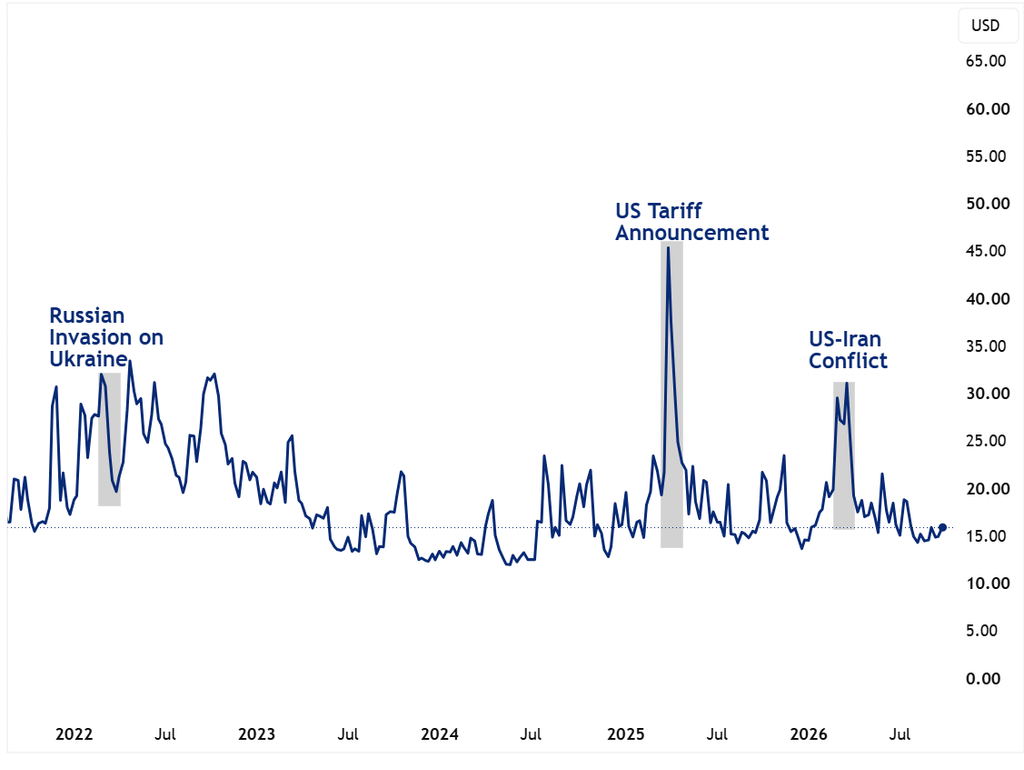
You can watch this pattern play out in the VIX, Wall Street’s best-known fear gauge. The VIX measures expected S&P 500 volatility over the next 30 days, based on options prices. The chart above highlights the major spikes in the VIX over the past 4 years.
How Markets React to Geopolitical Events
Impact on Stock Markets
The first thing investors do in a crisis is sell what they can’t price. It isn’t panic exactly, it's just that nobody can say yet whether the event lasts a week or a year. In the minds of investors, reducing exposure is cheaper than guessing wrong.
This is also where an index becomes misleading. Something like an oil shock can play out very differently for certain stock sectors. Energy producers, for example, will probably have a good quarter off the back of rising energy prices. Meanwhile, the airlines that buy the same barrel as jet fuel watch their costs run away from them.
If you're asking how wide the damage can spread across the stock market, it usually comes down to the following talking points.
- How many businesses are exposed to the disruption
- Whether they can raise their own prices without losing customers.
- How long the event lasts
A company with pricing power passes a cost shock through and carries on. A company without it absorbs the hit in its margins.
Historically, stock markets have recovered from most geopolitical shocks once the picture clears. The table below tracks the S&P 500 after major geopolitical events from 1941 to 2003.
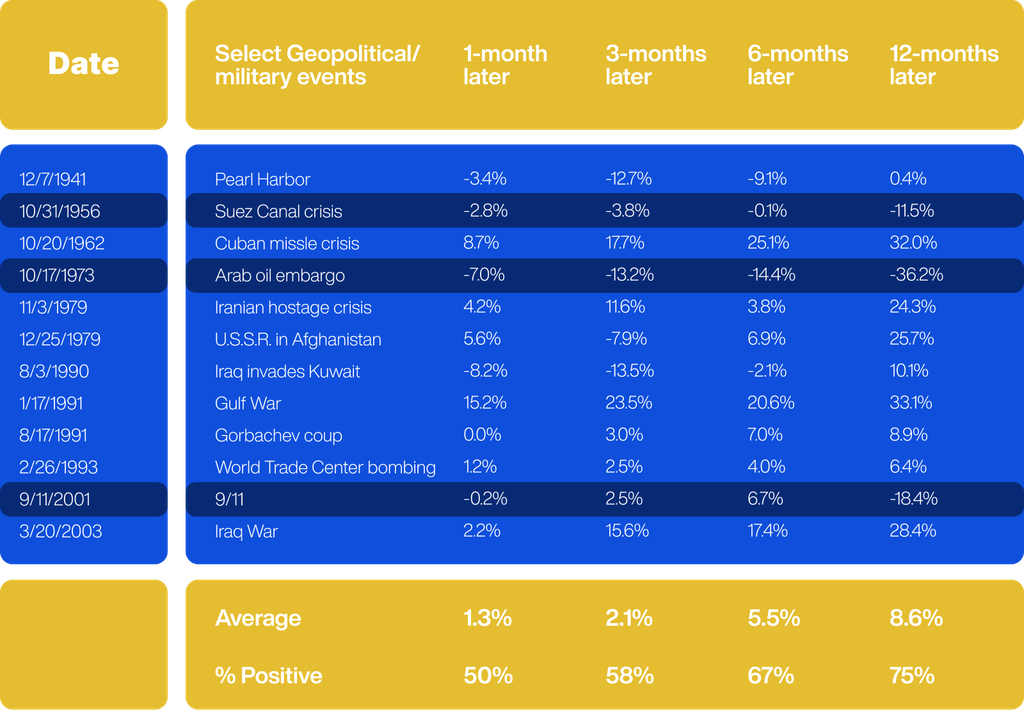
One month after each event, the average return was 1.3%, with only half of the events positive. After twelve months, the average was 8.6%, with three in four positive.
One exception was the 1973 Arab oil embargo, when higher energy costs added to inflation and recession pressures. The S&P 500 fell 36.2% over the following 12 months.
Forex Market Impacts
A currency pair compares two economies. When a crisis hurts a country’s exports or pushes investors to move their money elsewhere, its currency usually weakens.
The picture gets a little more complex when you bring oil into it. A jump in energy prices can increase import costs for an energy importer like Japan, while an exporter like Norway benefits from higher prices.
Even then, the outcome depends on the other currency in the pair and on what each central bank is expected to do with interest rates.
The Swiss franc and the Japanese yen are often described as safe havens, and in a standard risk-off episode, they usually take on this role. However, the yen is less reliable when the story is specifically about energy, for the reason above.
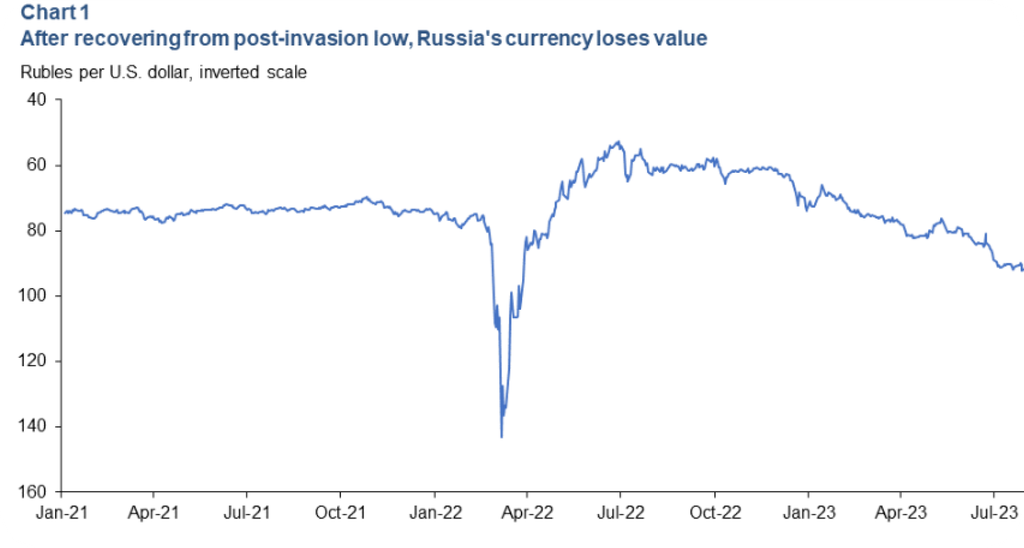
Government action can also change how a currency responds to a crisis. During the height of the Russian invasion of Ukraine, the Russian Ruble weakened past 140 rubles per dollar in early March 2022, then rebounded to around 52 by the middle of the year, surpassing its pre-war level.
Nothing about the Ruble's recovery reflected confidence in Russia's economy. Capital controls helped support the currency. By September 2023, however, it had weakened again to roughly 95 per dollar as export earnings declined and the trade surplus narrowed.
This shows why it matters to understand what factors drive a currency.
Commodity Markets
Commodities feel geopolitics first. Raw materials come from specific places and travel along specific routes. Close an important shipping lane and you lose a supply avenue.
Let's take oil as a clear example. Before the Iran war began in late February 2026, Brent crude traded around $70 a barrel. While the Strait of Hormuz was effectively shut, it briefly topped $126 in early May.
The more useful question is why it didn’t go higher. US crude inventories, including strategic reserves, fell by 79 million barrels as the world’s largest producer stepped in to fill the gap. Oil prices track the gap between lost supply and replacement supply, more than the headline itself.
Gold is where beginners usually get caught out. As a safe haven, you'd expect a war to send it higher. Yet gold hit a record $5,595 an ounce in January 2026 and had slipped to around $4,110 by June, with the Iran conflict still running.
The oil shock pushed US inflation to 4.2% in May, with energy costs up 23.5%. That raised expectations of higher interest rates, and gold pays no interest, so it gets less attractive when rates rise. Its safe-haven status is one force among several, and in an energy-driven crisis, it can lose.
Food follows the same logic. Back in 2022, wheat prices jumped because Russia and Ukraine are both major exporters and Black Sea shipping was at risk.
So with any commodity move, ask two things. How much supply is actually missing? And can anyone else replace it?
Interest Rates and Central Bank Policies
Geopolitics changes what markets expect from central banks. Disrupted energy supply lifts fuel costs, and those costs spread through prices across the economy.
Then comes the squeeze. The same energy bill drains households and businesses and slows growth.
Bond yields get pulled both ways. Inflation worries and expectations of tight policy push them up, while weaker growth and a rush into government bonds push them down.
Examples of Geopolitical Tensions
- 2026 Middle East Conflict: In late February 2026, the US went to war with Iran, and Iran shut down the Strait of Hormuz, which represents around 20% of the world’s oil. Brent crude surged from $72 to $126 before pulling back. The disruption in energy supplies contributed to inflation, which caused global central banks to hike interest rates.
- Russia-Ukraine War: Russia invaded Ukraine on February 24 2022, driving up the prices of oil, gas and agricultural products, as both nations were major commodity exporters. The STOXX 600 fell about 3.3% that day, leaving it roughly 10% below its January record high. Wheat prices climbed too, since Russia and Ukraine are both major suppliers, and the prospect of tougher Western sanctions added to supply worries.
- US-China Trade War: The trade war between the US and China began in 2018 and never really ended. President Trump’s tariffs in his second term pushed global stocks into bear market territory, and gold rose to new highs, reaching $3,500 per ounce. No shots were fired, yet it produced the biggest spike on the VIX chart above.
- September 11 Attacks: US exchanges stayed shut for four trading days after the attacks. When trading resumed on 17 September, the Dow fell almost 700 points, about 7%, and the S&P 500 lost 11% over the following week. Airline stocks plunged while defense stocks rose as the government raised defense spending.
Conclusion
Geopolitical events make it tempting to adopt an immediate assumption. War means higher gold prices. An oil disruption means higher crude prices. Political uncertainty means falling stocks.
But markets don't follow such simple rules. The more useful approach is to work backwards from the economic consequences.
If oil is rising, ask whether the supply disruption is likely to last and whether other producers can replace what's missing.
If a currency is strengthening during a crisis, look at capital flows, interest rate expectations and possible government intervention.
And if you see a sharp market move after a headline, consider how much of that news investors had already anticipated.
Above all, separate what has happened from what you think will happen next. They're two different things, and the second is far less certain.
Sometimes the most useful conclusion is that you don't yet have enough information to make one.
Share the knowledge
By Daman Markets Academy
This is not investment advice. Past performance is not an indication of future results. Your capital is at risk, please trade responsibly.